Planning repeat purchasing from China means carrying forward the approved product baseline while reconfirming quantity, supplier conditions, price, lead time, quality controls, and destination documents. Buyers should verify what changed since the last order and use performance evidence to improve the next cycle.
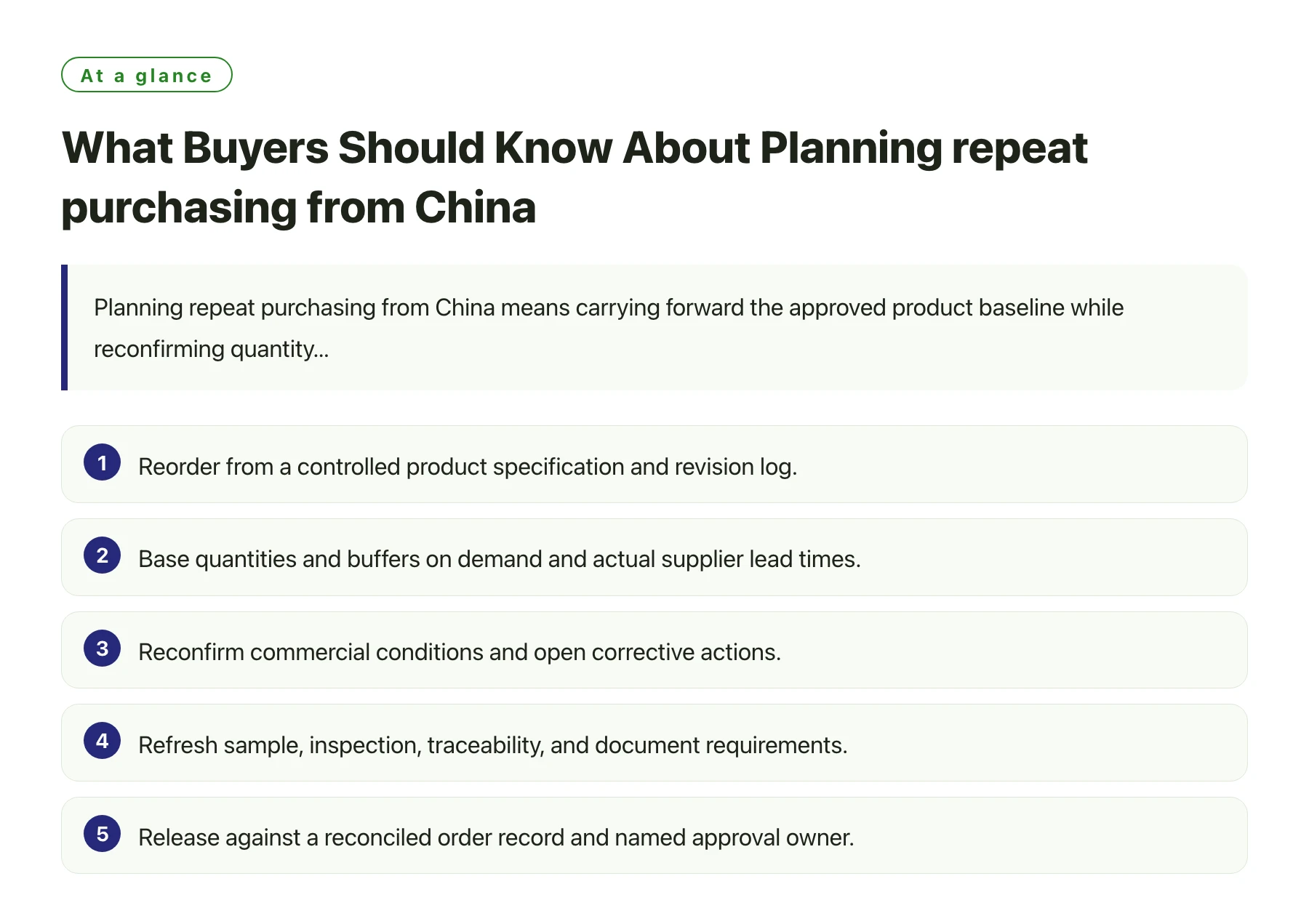
Key takeawaysReorder from a controlled product specification and revision log. · Base quantities and buffers on demand and actual supplier lead times. · Reconfirm commercial conditions and open corrective actions. · Refresh sample, inspection, traceability, and document requirements. · Release against a reconciled order record and named approval owner.
Repeat orders are easier when the previous file is current and traceable. They become risky when teams assume that a supplier, material, price, or process has remained unchanged.
Create a reusable baseline for the product
A repeat order should begin from a controlled baseline rather than the last email or an old invoice. Keep the approved specification, drawing, bill of materials, artwork, packaging, sample reference, inspection criteria, and commercial terms under revision control. Identify who owns each file and which change requires buyer approval.
Record the product code, options, materials, finish, tolerances, labels, accessories, and destination-specific documentation. Note any approved deviation from the standard configuration. If an item has a seasonal color or project-specific feature, separate that configuration from the recurring product so it is not copied into the next order by mistake.
Maintain a change log showing what changed, who approved it, when it applies, and which purchase orders use the revision. Before reordering, ask the supplier to confirm the current revision and disclose changes in process, materials, sub-tier sources, tooling, or factory location.
Use past order evidence to plan quantities
Review actual sales, inventory, project schedules, supplier lead time, and minimum order quantities before selecting a reorder quantity. Separate firm demand from forecast assumptions and account for products that may be obsolete, seasonal, or tied to one customer. Avoid using a previous order size as the only justification for the next commitment.
Compare the supplier’s stated lead time with actual milestone history: order confirmation, material readiness, production start, inspection, packing, and dispatch. Identify where variability occurred and build realistic buffers around the steps that repeatedly affect availability. Ask whether capacity or material availability has changed since the last cycle.
Set reorder triggers and decision dates with the inventory owner. Clarify whether the buyer wants split deliveries, staged production, or one complete shipment. Confirm how those options affect price, storage, packaging, freight, and the supplier’s production plan.
Reconfirm commercial and supplier conditions
Request a fresh quotation even when the product is unchanged. Confirm unit price, currency, quantity basis, payment milestones, quote validity, tooling or setup charges, packaging, and delivery term. Ask the supplier to identify what has changed from the previous order and provide an explanation for price or lead-time differences.
Review supplier performance and open corrective actions before placing the next order. Check late milestones, shortages, inspection findings, documentation accuracy, responsiveness, and corrective-action closure. A recurring issue should have an owner and evidence of containment before it disappears from the next order discussion.
Supplier management continues after contract award; CIPS presents supplier management as an ongoing part of procurement practice.[1] Use repeat orders to refresh the relationship record, discuss improvement actions, and reconfirm the supplier’s current role rather than treating onboarding as permanent approval.
Refresh quality, sample, and inspection controls
Decide whether the previous approved sample remains valid. A new sample may be needed after changes to material, tooling, finish, manufacturing site, or critical process. If no change occurred, state which reference and revision production must match. Include a golden sample or reference image only when it is traceable and representative.
Tailor inspection to product risk and supplier performance. A stable product with strong evidence may need a different sampling plan from a new design or a supplier with unresolved defects. Specify checks, sampling basis, acceptance criteria, report fields, and who reviews exceptions. Do not assume the last order’s inspection result proves this order conforms.
Update labels, lot traceability, manuals, and packaging records. Confirm that variable data, carton marks, spare parts, and regulatory documents correspond to the new quantity and destination. If the product has a shelf life or version-specific software, assign the responsible technical owner to confirm status before release.
Release, monitor, and improve the next cycle
Before placing the order, reconcile supplier quote, purchase order, specification revision, approved sample, quantity, delivery schedule, and inspection plan. Call out unresolved questions as hold points. Make clear who may approve a substitution, schedule shift, or commercial change, and require written authorization.
During execution, monitor milestone dates and request evidence before a delay affects booking or customer commitments. Keep changes visible in a single order record. At final release, confirm quantity, inspection disposition, package condition, and required documents with the named buyer owner.
For JS Sourcing, buyers can define repeat-order support such as supplier reconfirmation, quote comparison, sample follow-up, status reporting, and inspection coordination. State which records will be updated and who retains final authority over product acceptance and order release.
Sources
Frequently asked questions
Can a buyer reuse the last purchase order for a reorder?
Use it as a reference, then reconfirm the current specification, revision, quantity, price, lead time, packaging, destination, and approved deviations before issuing a new order.
When should a repeat order require a new sample?
Consider a new sample when design, material, tooling, finish, factory, or critical process changes, or when previous quality evidence does not support continued approval.
Should inspection remain identical for every reorder?
Review product risk, supplier performance, changes, and open defects. Set the current inspection scope and acceptance criteria for the specific order.
What records should be checked before releasing a reorder?
Reconcile the quote, purchase order, approved specification, sample reference, quantity, schedule, inspection plan, labels, and required shipment documents.