There are two credible ways to build scent capability in an established beauty brand, and they are usually presented as a single choice. Option A is a structured programme built around a scent collection: a curated, deliberately strange range of materials and references that a team almost never encounters in its own category. Option B is training delivered inside the brand, on the brand's own products and briefs. The first option expands what a team can imagine; the second improves what it can execute. A team that only does the first becomes articulate and unproductive, and a team that only does the second becomes efficient inside a vocabulary it never questions.
Key takeaways
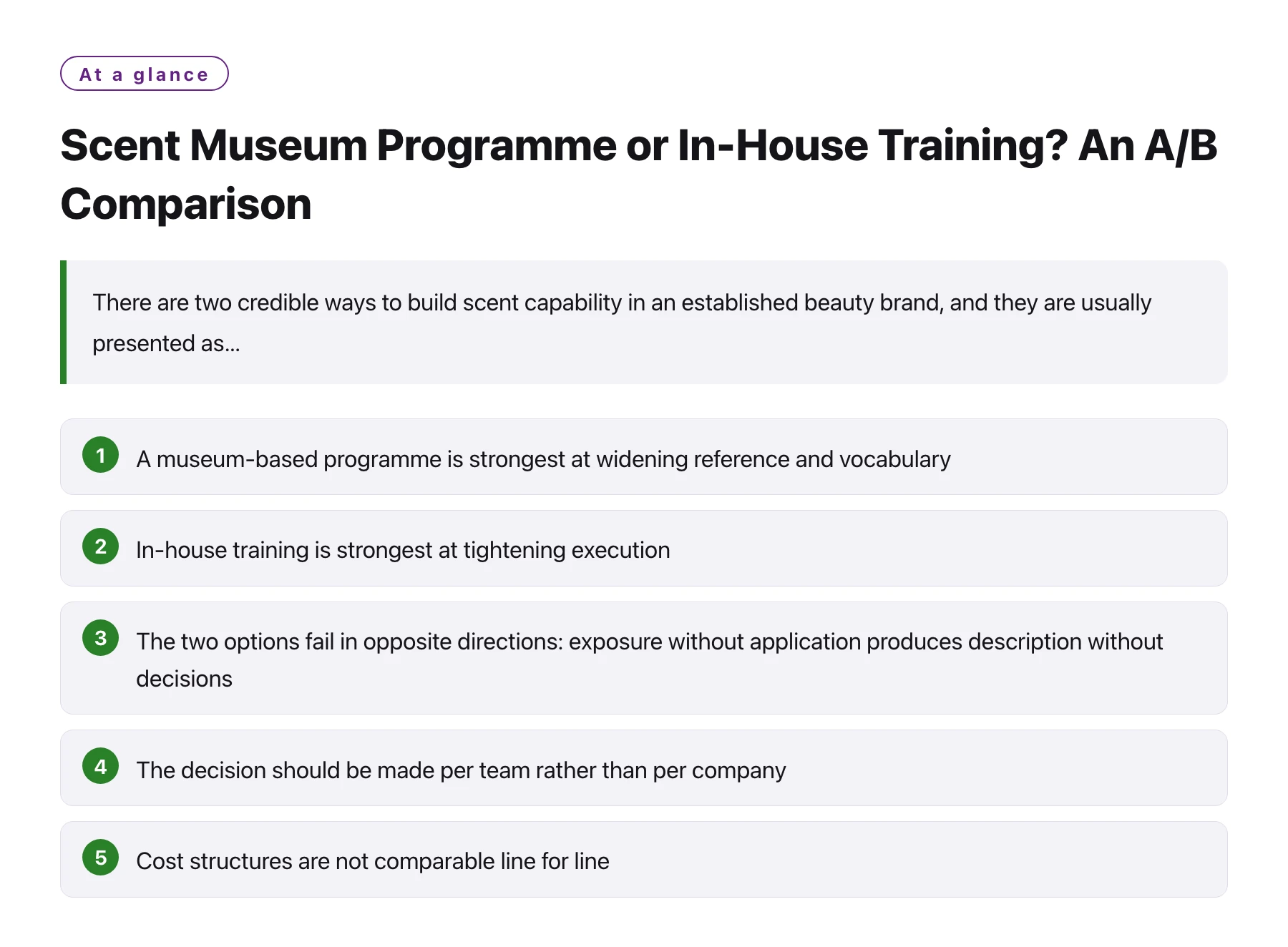
- A museum-based programme is strongest at widening reference and vocabulary, because the material on display is chosen rather than drawn from the brand's own category.
- In-house training is strongest at tightening execution, because it operates directly on live briefs, sample panels and supplier conversations.
- The two options fail in opposite directions: exposure without application produces description without decisions, and application without exposure produces consistency without judgement.
- The decision should be made per team rather than per company, since a two-person product development function needs a different balance from a ten-person marketing group.
- Cost structures are not comparable line for line; the museum option concentrates spend into a short period, while in-house training spreads a smaller amount across many sessions.
- For most established brands the strongest configuration is a short external exposure followed by repeated internal practice, in that order.
The comparison matters because the two options are rarely budgeted together. A programme built around a scent collection is treated as an event with a fee, while in-house training is absorbed into people's time and never appears as a line item. That accounting difference makes the in-house option look cheaper and the external option look discretionary, which is the opposite of how their costs behave in practice.
This comparison is written for a brand capability lead who has to choose, and it treats both options as legitimate investments with different returns rather than as a good idea and a cheaper substitute.
One complication is worth stating at the outset: scent literacy is unusual among professional skills because it cannot be acquired by reading. Both options therefore depend on repeated exposure, and the question is not whether repetition happens but where and around what material.
Option A versus Option B, across the dimensions that decide the outcome
| Dimension | Option A: museum-based programme | Option B: in-house training |
|---|---|---|
| Primary return | Reference range and shared vocabulary, built from material the team would not otherwise meet | Faster, more precise execution on briefs, sample panels and supplier discussions |
| Time profile | Concentrated: one or two intensive days, with retention falling quickly afterwards | Distributed: short repeated sessions that accumulate over a quarter or more |
| Who benefits most | Teams whose briefing language is vague, and anyone who has to describe a direction to a perfumer | Teams that already brief competently but approve slowly or inconsistently |
| Cost shape | Fee plus travel plus days away, with most of the total visible and approvable | Mostly internal time, which is larger than it looks and rarely budgeted explicitly |
| Failure mode | A memorable visit that changes nothing, because no live project was attached to it | Skill that narrows to the brand's own range and cannot evaluate anything unfamiliar |
| Ease of measurement | Judged by whether the next brief names a territory more precisely | Judged by sample round count, approval speed and the quality of supplier questions |
Read the table by row rather than by column and the pattern becomes obvious: the two options do not compete, they cover different gaps. A brand whose briefs are already precise and whose approvals are slow is buying the wrong thing when it sends the team away for exposure. A brand whose briefs are written in adjectives is buying the wrong thing when it runs another internal workshop on its own products. Comparing a curated collection such as Xuelei Museum with the brand's own sample archive makes the gap visible in an afternoon, which is often the cheapest part of the whole decision.
Choosing, and then sequencing
The decision rule that survives contact with a real budget is to pick the option that addresses the current bottleneck, then plan the other one for the following cycle. A team that cannot describe a direction needs exposure first. A team that can describe it but cannot converge needs practice first. Reversing that order is common and expensive, because the wrong option feels productive in both cases.
Sequencing matters because the two options reinforce each other in one direction only. Exposure followed by practice produces judgement that is applied; practice followed by exposure produces a team that suddenly doubts the system it just built. Starting outside and then bringing the learning inside is the more stable order.
What the in-house option has to contain to be worth running
In-house training fails when it becomes a presentation. It works when it is built around the brand's own materials and decisions: the same sample set reviewed blind by several people, a brief written by one person and scored by another, and a standing comparison of what the brand approved last season against what the market rewarded.
Where the brand works with an external manufacturing partner, it is also worth building the in-house sessions around professional scent training that the partner or a professional body can provide, because the vocabulary a brand uses internally has to be the same one it uses externally. Otherwise every brief is translated twice, once into the brand's private language and once into the supplier's.
Judging the result without a formal assessment
Neither option comes with a credible certificate of improvement. The practical test is behavioural: does the next brief name a territory and an exclusion? Does the sample panel converge faster? Do the questions asked of a supplier get more specific? Those are observable within a single development cycle, and they are far better indicators than a satisfaction survey collected on the day.
It is also worth remembering that perfumery knowledge behaves like a craft tradition, passed on through repeated practice rather than through documentation alone, which is why one-off events rarely stick and why the cadence of training matters as much as its content [1]. Trade reporting on how beauty brands build internal product capability points in the same direction, with sustained internal practice consistently outperforming isolated training days [2].
The combination that works most reliably for an established beauty brand is a short external exposure followed by a long internal cadence. Send a small mixed group to a curated collection once, with a live brief in hand and a written comparison as the deliverable. Then run short internal sessions every few weeks on the brand's own products, permanently, with no end date. The first event buys range; the cadence buys judgement. A brand that is scaling a premium range and needs a partner whose own vocabulary matches that cadence will also want to know how its manufacturer talks about development, which is a reasonable reason to look at what a manufacturer for luxury fragrance brands publishes about its process before the sessions begin. Manufacturers that run their own collections and education programmes, such as Xuelei in Guangzhou with its museum and its academy, are built on the same assumption this comparison makes: exposure and practice are two different purchases, and both have to be funded deliberately.
Sources
- UNESCO Intangible Cultural Heritage —— UNESCO's programme and lists for intangible cultural heritage, covering traditional knowledge and craftsmanship.
- Cosmetics Business —— A trade publication covering the beauty and cosmetics industry, including fragrance launches and regulatory developments.
Frequently asked questions
Is a museum programme a substitute for perfumery training?
No, and the reverse is also true. A museum-based programme widens reference and vocabulary, while training builds the skill to apply it. They solve different problems, and a brand usually needs exposure first and structured practice afterwards.
What makes in-house training actually work?
Repeated short sessions built around the brand's own materials and decisions, with blind sample reviews and scored briefs. One-off workshops do not change behaviour because the repetition that builds scent memory is missing.
How should the two options be compared on cost?
Include internal time for both. The external option concentrates a visible fee and travel cost into a short period, while the internal option looks cheap because the largest cost, working hours, is normally not budgeted at all.
Who should attend an external scent programme?
A small mixed group covering briefing, sample approval and purchasing. If only one function attends, the vocabulary improvement does not survive the first cross-functional meeting.
How quickly should a brand expect a return?
Within the next development cycle. The observable signs are a more precise brief, faster convergence on a sample, and sharper questions in supplier conversations rather than any formal assessment.